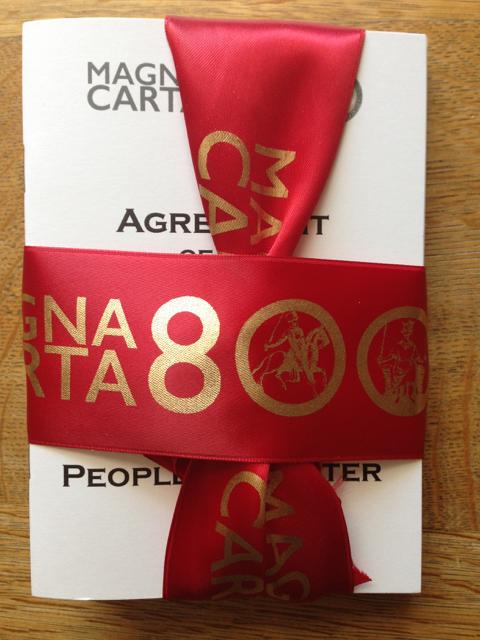
800 years ago on June 19th 1215 King John was forced, by Archbishop Stephan Langton and a group of barons, to sign the Magna Carta – a document setting out limits to the king’s power and guaranteeing the pre-eminence of the rule of law over the executive. John almost immediately repudiated it, but over the next 80 years or so it was re-issued several times, with the 1297 version extending the freedoms it offered to free men across the land. Alongside Magna Carta (and the 1217 Charter of the Forest, or Little Charter) the 13th Century in England featured the calling of the first English Parliament and with it the establishment of the foundations of modern democracy and a just and fair society.
To celebrate the events at Runnymede on 19th June 1215, I am selecting a series of manifestos and texts written over the centuries that build upon the Magna Carta’s legacy in their own period of history. Each month, from January to June 2015, I will juxtapose two or more texts in a book made with and shared on bookleteer (and distributed as physical copies to subscribers of the Periodical) as a way of reflecting that, across the generations, the quest continues apace for a fair and just society in which the rights and responsibilities of individuals are respected and upheld without prejudice. By re-presenting these ideas in a series of books I hope others can also draw inspiration from them and help frame the questions and challenges that face both the UK and other countries in the time ahead of us.
- January – An Agreement of the Free People of England (1649) & The People’s Charter (1838)
- February – Bill of Rights (1689), Declaration of Independence (1776) & Declaration of the Rights of Man (1789)
- March – The True Levellers Standard Advanced (1649) & Charter of Fundamental Rights of the European Union (2000)
- April – Petition of Right (1628), Grand Remonstrance (1641) & Charter88 (1988)
- May – Common Sense Part 1 (1776) & Agrarian Justice (1795) by Thomas Paine + the Universal Declaration of Human Rights (1948)
- June – Charter of Liberties (1100), Magna Carta (1215) & Charter of the Forest (1217)
I’m particularly keen to shine a light on ideas and writings from periods such as the mid-17th Century that have inspired me in developing my own sense of what a just and fair society might be like and how it could function. There is much we can learn today from those called Levellers and Diggers – what they sought then has resonated across the centuries and still seems so relevant in our own time. Perhaps we are seeing history repeat itself : then, a chance was missed during the Interregnum (or Commonwealth) for a new kind of society to emerge that could have swept away inherited privilege and arbitrary exploitation of the poor and landless. Instead, the power of the City, landowners and merchants usurped the dominance of king and nobility. Now, over three hundred years later we are seeing the Welfare State – a kind of postwar commonwealth – being dismantled by a similar nexus of wealth and privilege. This process goes hand in hand with the rapacious exploitation of the natural world, subtly reinforced even among environmentalists by the placing of money values on natural ‘resources’ as an argument for their protection from extraction. In this way, every relationship humans have to each other or to the ecologies we live within are divorced from context and connection with the flow of life – anything which could bind us to people and place in ways other than can be defined by money. By elevating money as the paramount value, we are isolating ourselves from each other, from inherent rights and from any sense that we have intrinsic responsibilities and obligations to others and the world we live in.
I’ve begun the series with a book containing two texts written roughly two hundred years apart, at the apogee of two great moments of change in the UK – the English Civil Wars and the Chartist movement. Both sought radical change to the status quo of how the country was governed, laying crucial foundations for the development of our modern parliamentary democracy and for a just and fair society based on individual rights and responsibilities. That both were rejected by those in power in their own times is a reminder that each generation must continue to strive for its own version of a just and fair society. These texts serve as an inspiration for us now to continue to question and challenge the Powers That Be – to reject their surveillance state, their dismantling of the Welfare State, their greedy pilfering of the commonwealth for their own private gain. And to remind ourselves that, across the centuries, others have stood firm against tyranny whatever form it takes.
If you’d like to receive the physical versions of the books, please subscribe to the Periodical here. And there’s now a special limited edition (40 sets only) bound together with a red satin ribbon, buy your’s here.
You can, of course, also read each book for free, either online in their book reader versions or if you download, print out and make up the handmade versions – just visit bookleteer and browse the collection.




 Giles Lane
You must be logged in to post a comment.